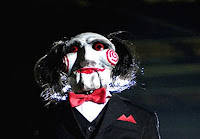
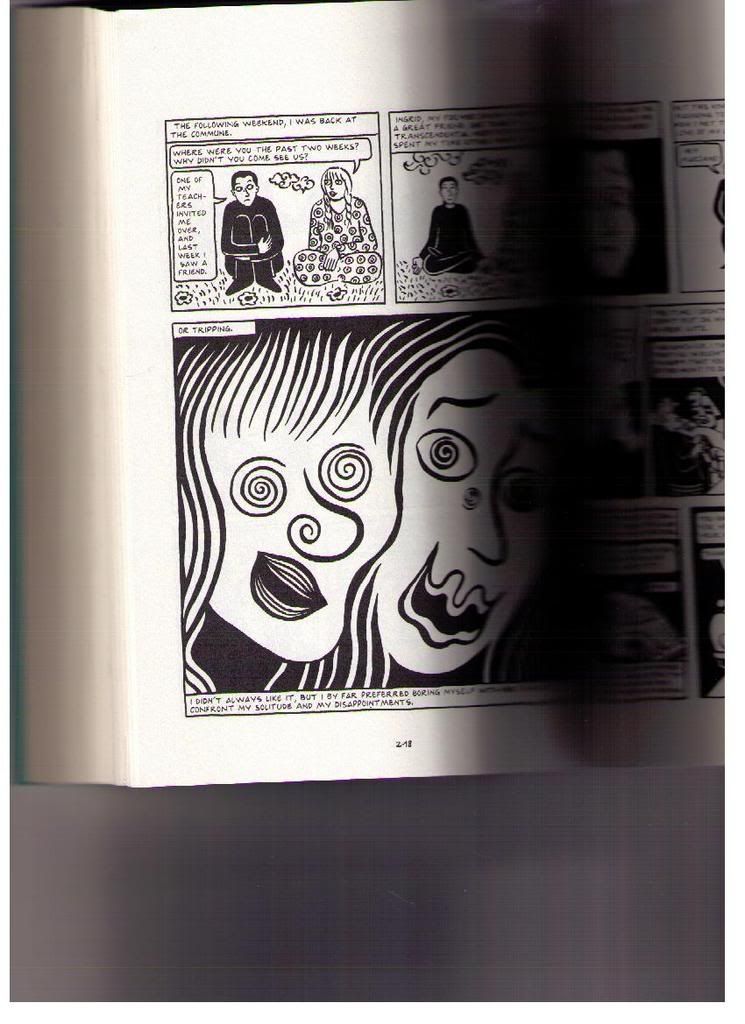
This picture is from page 218, when Marji and Ingrid were doing Yoga. i thought this this picture is funny. It showed a kind of emotion that we can't do in real life. i think what Marji was trying do is to express an uncomfortness that she was having after she found out that her first boyfriend, Enrique, is homosexual. In page 214, " It was inconceivable. First my eight housemates and now my boyfriend [is homosexual]".
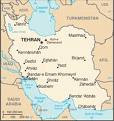
Map of Iran
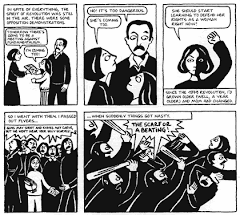
Graphic Novel Example Panel
Sunday, March 8, 2009
Kevin Week 2 Category 4: Snipets
This picture is from page 218, when Marji and Ingrid were doing Yoga. i thought this this picture is funny. It showed a kind of emotion that we can't do in real life. i think what Marji was trying do is to express an uncomfortness that she was having after she found out that her first boyfriend, Enrique, is homosexual. In page 214, " It was inconceivable. First my eight housemates and now my boyfriend [is homosexual]".
Geneva Week 2 Category 3: Literary Feature Hunt
Marjane's Pointed finger, when stating "But our governmetn was against it" (Satrapi, 114) and continuing to the following panel "They declared" (Satrapi, 114). These two uses of text are an example of a Scene to Scene connection. The introduction of the next scene and also the re-occuring image of a pointed finger. At first, the finger is Marjane's, but then it changes to a black sleeve, and becomes the main voice of the public. Meanwhile, Marji's hand is in the same position as the darker sleeve, its is just that the hand is flipped over and pointing towards the public. This is interesting because teh public islooking up and they are mesmerized by their 'leader'. This could, in fact, lead us to believe that the leader is her. Because the all male public reaction to their leader appears shocked and they are looking up, because she is part of the "they" whom she mentions in her text. Without putting a face to the commands, Satrapi really opens up the interpretation that could follow. The single hand could reflect Satrapi's common use of identifying with the characters and matching images to her graphic symbols.
- This character has a possible family, so does Winston
- This character is fighting for the freedom, Winston is fighting for the freedom
- This character is fighting for his beliefs, Winston fights for his beliefs
Clearly the two story-lines are similar with what the fighters go through and their suffering.
It is interesting to question why Marjane Satrapi chooses this image specifically. Especially when the text states "to inject" rather than "to spurt" or "to ooze". The typical image that comes to mind with injections are needles. It is interesting to see other interpretations of this image, without the text acompanying.
Geneva
Geneva Week 2 Category 2: Feedback
Their deaths represent a side that can be grasped through an empathetic perspective. The children may have explosions coming from them, because they are dying for their country. Instead of suicide victims, they are considered martyrs to their people. So it is plausible that these children are not killing themselves, but their country (which is a sum of their part*) is killing itself by killing its people and passing this off by honoring those who died and calling them martyrs. This theory may be supported by the author, where Marjane Satrapi does not identify any faces to the children or any background to the explosion.
The purpose of leaving the faces blank is a true statement stated by Marjane herself, in an interview at the New York Film Festival. This clip can be found at:
http://stratfordhallmcguigan.blogspot.com/ under 'Satrapi Interview' in the second film clip 'Marjane Satrapi: A pro-iranian humanist tale.'
The idea of faceless recognition and having an open interpretative identity for these child soldiers was initially brought to our attention by Mr. McGuigan on the day that we were going through all of these snippets and getting his feedback. The day we learned about Satrapi's true perspective was a day after hearing Mr. McGuigan's initial interpretation. His interpretation began by a discussion of the following panel on page 102. The children and Marjane partying versus the child soldiers exploding were a juxtaposition of similar actions. This idea was led by Mr. McGuigan but the literary feature was brought up by Richard (I believe?) or Evan.
The similar actions between the two contrasting and paradoxical panels were an interesting use of a Scene to Scene transition. Our class discussion led us to believe that the similar spacings, setup and time were meant for us to identify with a character.
My identity was initially leaning towards Marjane and her friends partying while a war was going on in her own 'backyard'; however, there was a specific reason for leaving the faces blank, and Mr. McGuigan pointed out that the blank faces required an identity. This means that those child soldiers could be you. Although that point is a plausible explanation for the situation and what is 'meant to be' (what the author is trying to tell us), I could not help but thinking that, realistically, I would relate more to Marji and her friends, rather than the child soldiers. While reading the text and dissecting the pictures, I can relate to the children and empathize for their loss, effort and desire to 'change the world' (which I can literally relate to), and while i wear a key necklace myself (sometimes), I could not relate to them whole heartedly (Nor could I picture myself in the panel). But when looking at the following scene, I could relate. I could feel the ignorant, helpless, censored and innocent tone that arose from the image. Her bugged eyes are almost a forced happiness, and the fact that she is facing us, makes the panel appear to be at the back of her mind, just like the thought of the war and other soldiers was always at the back of her mind.
There is another contrast represented through symbolism. Marjane's necklace in the second panel was made of "chains and nails" (Satrapi, 102) and the key necklaces hanging from the child soldiers in the first panel. Keys usually have a positive and hopeful connotation, with a sense of a secrecy and faith; whereas, nails and chains tend to have a negative and violent connotation. This second juxtaposition is almost another yin-yang balance* where the negative symbol is within the happier and ignorant scene, and the positive symbol is in the negative and violent scene. As if the scenes and symbols were switched to leave a shred of memory of the situation that they experience.
*Reference to IB questioning discussion Number 4: "We are more than the sum of our parts." Explain this statement in relation to Persepolis.
*Also mentioned in another snippet on page 6
Geneva
Tuesday, March 3, 2009
Geneva Week 2 Category 1: Class Act
+
=The Literary JigsawIn class, Mr.McGuigan assigned us five questions that were mixed with a series of IB diploma exam questions. Each one was supposed to relate to Persepolis. We answered this in groups and divided it up by table and had mini-discussions of each question (one person per question per table) after we clarified our answers to our original questions (most of us took notes).
My question was Question #2.) How does Satrapi approach the art of storytelling?
Table Partners: Rushil, Manny and David
Satrapi uses different mediums to connect to a range of people. Persepolis is a universal graphic novel because it depicts relatable aspects of life for people of different ages. For example, Page 77, uses Aladdin's Magic Carpet to highlight the text's meaning and the representation of the common childhood tale signifies the fact that Marjane is still a kid in that chapter, although she may think as if she were an adult. With all her grand ideas Marji is a dream chaser. Marjane looking back on her life in this auto-biographic graphic novel looks at the different places she goes by using her childhood stories (Aladdin) and her personal adventures with her "parents [whom] abruptly planned a vacation" (Satrapi, 77).
She makes her story universal and relatable, this makes it easier to connect to as a first person story. Satrapi allows others to connect to he message of hardships portrayed in the graphic novel. This is done by emphasizing her minority status (as a child, as a woman, as an Iranian, as a common citizen, as a rebel). Page 20 describes the historical relationship between Iran and Britain. This historical reference connects to the Iranian and British foreign policies. Both serving as relative historical interpretation of universal common knowledge.
Based upon what Persepolis explains about Marjane Satrapi's life, she allows the audience to read into the 'truth' that she has created or lived. Every event is mandated as fact, but it is difficult to determine if the situations in Persepolis are fact or fiction...Clearly, this is a limitation. Not only was the original Persepolis written in French, this graphic novel is Marjane Satrapi's adaptation and abbreviation of the occurrences in Marjane Satrapi's life. This serves as support that the information put in may not be entirely true, but it is also not the entire happening of the situation.
Through a blend of dialogue and text, Satrapi tells her story by:
- Connecting to a wide range of people (Universal)
- Symbolism and photos re-affirm her text and vice versa
- She tells the truth (from what we can tell) about her life
- Makes Marji a likable protagonist (similar to 1984)
- Her story is circular
- Looks back on her life
- Censors what she wants people to know and what she knows occurred
- Both text and art tell a story, but are both linked in idea
- There is a purpose
- The text is accessible
Sunday, March 1, 2009
Kevin Week 1 Category 4: Snippets
Kevin
Geneva Week 1 Category 3: Literary Feature Hunt
On page 43, th dragon framing the second to the last panel is an exact demonstration of symbolism. The use of this different panel frame is like a graphic artists version of pointing arrows and signs and smothering them in neon highlighter, at a siginificant part of the book--by drawing an interesting picture that does not fit with the original formality of the book.
This dragon can represent "the devil [that was supposed to] le[ave]" (Satrapi, 43), but instead remained. Only Marjane is able to see the dragon (representing the devil) in the window pane, and both her parents are "blinded" (Mr.McGuigan, February 25) which is why their eyes are closed in the image.
The text and imagery can portray a message that cannot be transfered to the human brain through a classic novel. The story explained by content of the text and form of writing and imagery are explained by the words used and enhanced by the photographs provided. So the images are like Shakespeare's play as if there were stage direction and a clearer image of the play's physical aciton.
It is also interesting to note that the face of the "devil" bares similar features to the former Shah Reza of Iran.
More Later... <3
Geneva
Geneva Week 1 Category 2: Feedback

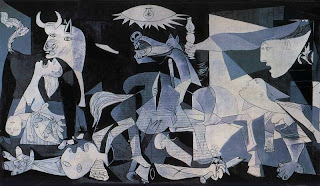
was brought up because of Pablo Picasso's use of 3D dimensions on a 2D canvas, with images almost sticking out on a flat surface.
This also connected to our in class discussion with Ms. Brownwrigg. She brought to our attention the concept of Panel Transitions. When we learned bout 'Aspect to Aspect' transitions, the idea of looking at one image from different angles brought up this painting again.
Megan actually was the one who brought to my attention the text that refered to the bicycle in the first place. Actually, when I was scanning the pages for more snippets, I was just technically interested in the photo rather than the text, and didn't even notice the text reference until after she pointed it out.
It will be interesting to see the other snippets that come to class next week...
:D
More Later...<3
Geneva